
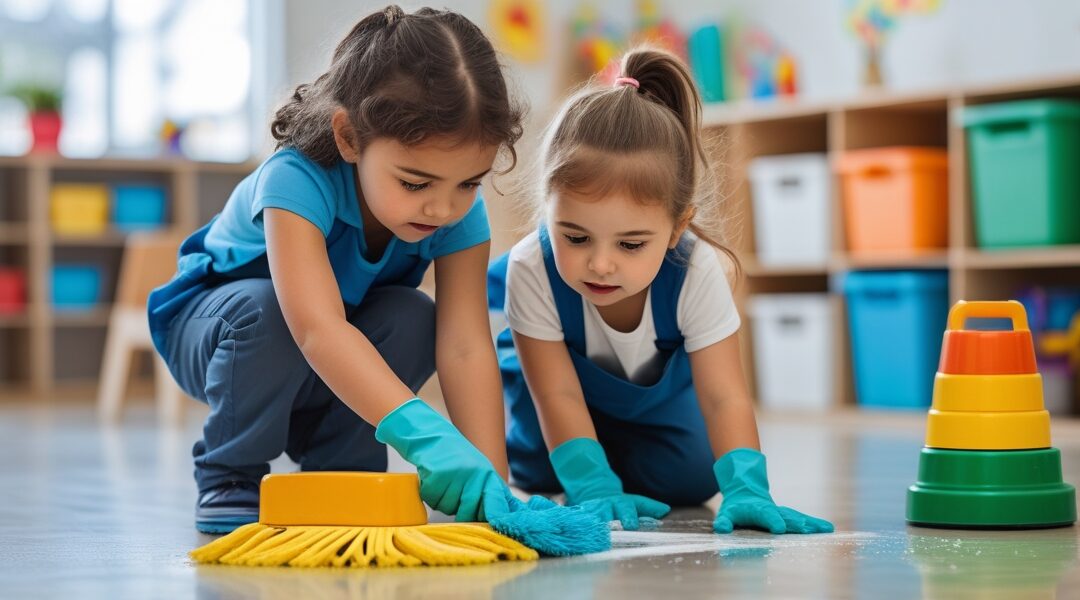
Childcare Cleaning: Working With Children Checked in VIC — Best Practice Guide
This comprehensive guide explains the obligations, practical steps and best-practice processes for cleaning staff who operate in early childhood services in Victoria. It covers whether cleaners need a Working With Children Checked (WWCC), how to obtain and maintain the check in VIC, relevant legislation and standards, infection control, documentation and recommended cleaning routines to keep centres safe, compliant and child-friendly.
Why this matters: safety, compliance and reputation
Early childhood services are high-trust environments. Families and regulators expect robust systems to protect children from harm and from preventable illness. Cleaners who enter these settings — whether employed directly by a centre, contracted through a cleaning company, or engaged as casuals — need to understand both legal obligations and practical infection-control measures.
Do cleaners need a Working With Children Check in Victoria?
Short answer: in most cases, yes. A Working With Children Checked (WWCC) is required for people in “child-related work” in Victoria. If a cleaner’s role brings them into contact with children or gives them unsupervised access to children (even occasionally), they must hold a valid WWCC.
Key points:
- Anyone doing paid or volunteer work that is classified as child-related work in Victoria must generally have a WWCC.
- Cleaning staff who work outside hours but enter areas where children are present, or who clean classrooms, sleep areas, nappy-change areas or playground facilities, typically fall within the scope of child-related work.
- Employers and service operators are responsible for verifying that cleaners and contractors have a current WWCC before allowing them into child-facing areas.
How to get a WWCC in Victoria (practical steps)
The WWCC is administered by the Department of Justice and Community Safety in Victoria. The process is straightforward:
- Apply online through the official Victorian WWCC portal — you will need ID documents and personal details.
- Pay the application fee if applicable (fees vary for volunteers and paid workers).
- Undergo the police-record check and screening process. The outcome will be either a clearance or a bar.
- If cleared, you’ll receive a WWCC card or an online clearance that can be checked by employers. Clearances require renewal (typically every five years) — keep track of expiry dates.
Relevant Victorian legislation and standards
Cleaners and service providers should be familiar with the legal framework that intersects with childcare cleaning and staff screening. Important references include:
- Child Wellbeing and Safety legislation and guidance relevant to child-safe environments.
- Child Safe Standards and obligations overseen by the Commission for Children and Young People (CCYP) in Victoria.
- The National Quality Framework (NQF) for early childhood education and care — the Quality Standards include requirements for health, safety and facilities management.
- State public health guidance from the Victorian Department of Health (DH), particularly on infection prevention and outbreak response.
Employer responsibilities
Early childhood service providers and centres must:
- Verify WWCC status for all staff and contractors who undertake child-related work, including cleaners.
- Retain evidence of checks and record expiry and renewal dates.
- Ensure that contractors and cleaning companies provide appropriately screened staff, or supervise any staff without a WWCC so they do not engage in unsupervised child-related activities.
- Include WWCC requirements in contractors’ agreements and procurement documents.
When might a cleaner not need a WWCC?
There are limited circumstances where a cleaner may not require a WWCC — for example, if cleaning is performed outside service hours and the worker absolutely has no opportunity to interact with or be in the presence of children (and access is strictly controlled). However, the risk of incidental contact is high in childcare settings, so centres typically require a WWCC as a prudent minimum for anyone entering the premises.
Additional background screening and checks
Beyond the WWCC, many centres request or require:
- National police checks (where relevant).
- Reference checks from previous employers.
- Proof of identity and right to work in Australia.
- Immunisation evidence or vaccination policy compliance for certain illnesses.
Infection control and cleaning standards in childcare settings
Cleaning in childcare is about both visible cleanliness and reducing infectious risk. The following principles reflect current best practice used by providers across Victoria:
- Prioritise high-touch surfaces: benches, door handles, taps, toys, light switches, tabletops and nappy-change surfaces.
- Use appropriate disinfectants and follow manufacturer contact times — cleaning first (removing dirt) then disinfecting is the correct sequence.
- Establish daily, weekly and deep-clean schedules and document completion with logs.
- Use colour-coded cloths and equipment to prevent cross-contamination (e.g., separate sets for bathrooms, food areas, playrooms).
- Launder soft toys and bedding regularly according to instructions, using hot water cycles where safe and appropriate.
Recommended cleaning frequencies and tasks
The following is a practical schedule that childcare services commonly adopt. Adjust frequency according to centre size, occupancy, local public health guidance and outbreak status.
- Daily (during service hours): frequent wipe-downs of high-touch surfaces, toy rotation and spot-cleaning of spills and bodily fluids.
- After each nappy change: clean and disinfect nappy-change surfaces and safely dispose of waste.
- End of day: thorough cleaning of play areas, bathrooms, kitchen/food-prep areas, and mopping floors with suitable disinfectant.
- Weekly: deeper cleaning of furnishings, wash toys in warm soapy water or dishwasher if appropriate, clean storerooms and vents.
- Monthly/quarterly: deep clean carpets/matting, dusting of ceilings and high areas, review and refresh cleaning chemicals and equipment.
Documentation and record-keeping
To demonstrate compliance and good governance, childcare services should keep:
- Records of WWCC checks for each worker and contractor (including expiry dates).
- Daily cleaning logs signed by staff or contractors.
- Risk assessments for cleaning tasks (e.g., chemical use, working at heights to clean fans, handling bodily fluids).
- Training records for cleaners — infection control, manual handling and chemical safety (SDS awareness).
Training and competency for cleaners
Appropriate training reduces mistakes and enhances child safety. Training should include:
- Child-safe awareness and respectful conduct when in a child-centred environment.
- Infection prevention and control: correct use of disinfectants, PPE and hand hygiene.
- Safe handling of cleaning chemicals, interpreting Safety Data Sheets (SDS), and manual handling techniques.
- Centre-specific procedures — where to clean, how to enter rooms, what to do if encountering children, and emergency procedures.
Personal protective equipment (PPE) and safe chemical use
Cleaners should be supplied with appropriate PPE (gloves, eye protection where needed, aprons) and trained to use it. Use child-safe, approved cleaning products and never mix chemicals (e.g., bleach and ammonia). All chemicals should be stored securely and out of children’s reach.
Immunisation and health expectations
While WWCC focuses on safety screening, many centres also require or strongly encourage vaccinations for staff and contractors to reduce outbreak risk. Typical expectations include up-to-date immunisation for:
- Influenza (seasonal).
- COVID-19 — follow current DHHS guidance for boosters and recommended doses.
- Standard immunisations such as tetanus; hepatitis B for those at occupational risk may be recommended by the employer.
COVID-19 and respiratory illness considerations (current best practice)
Although the acute phase of the pandemic has passed, COVID-19 and other respiratory viruses remain a consideration for childcare settings. Best practice includes:
- Maintaining good ventilation: use mechanical ventilation where available, open windows when safe, and use portable HEPA filtration in enclosed spaces if required.
- Cleaning high-touch surfaces frequently — while surface transmission is less dominant than airborne routes, cleaning reduces contamination and gives parents confidence.
- Following local DHHS outbreak guidance when cases rise: enhanced cleaning, communication to families, and additional infection-control measures as recommended.
Practical on-site arrangements for cleaners
To keep children safe and ensure regulatory compliance, centres commonly implement:
- A register of all contractors and cleaning staff who access the site, including WWCC details and expiry dates.
- Clear sign-in/out procedures and supervision rules for any workers without a WWCC (they should not be left alone in child-accessible areas).
- Restricted access to child sleeping areas, medication storage and any sensitive records.
Working with cleaning contractors: procurement checklist
When engaging an external cleaning company or contractor, include these items in contracts and procurement checks:
- Evidence that all workers performing child-related work hold a current WWCC.
- Public liability and workers’ compensation insurance certificates.
- Agreement that the contractor will adhere to the centre’s child-safe policies and cleaning schedules.
- Evidence of relevant training (infection control, manual handling, SDS awareness).
- Right to audit cleaning records and conduct spot checks.
How to communicate cleaning and safety to families
Transparency builds trust. Consider sharing:
- Overview of cleaning schedules and how often toys and surfaces are cleaned.
- Assurance that cleaners are WWCC-checked and trained.
- Information on infection-control policies and what parents can do to support (e.g., keeping unwell children at home).
Useful resources and further reading
To learn more about childcare cleaning, screening and regulatory obligations, review materials from the Commission for Children and Young People, Victorian Department of Health, and the National Quality Framework. For practical examples of service providers and specialist cleaning companies that deliver to early childhood centres, see the examples linked below.
Summary checklist for centres and cleaners
Use this short checklist to confirm compliance and best practice:
- Confirm WWCC for all cleaners and contractors doing child-related work; record expiry dates.
- Keep daily cleaning logs and incident reports for spills or infectious episodes.
- Ensure cleaners receive training on child-safety, infection control and chemical safety.
- Use appropriate disinfectants and follow manufacturer instructions for contact time and dilution.
- Maintain ventilation and waste management systems, and follow DHHS outbreak guidance when required.
Final notes — practical, legal and ethical responsibilities
In Victoria, the combination of legislative obligations and community expectations means that childcare cleaning is not just about removing dirt — it is a child-protection and public-health activity. Centres must treat screening and training seriously, and cleaning staff should be supported with the tools, training and clear instructions they need to do their job safely and effectively.
If you operate, manage or supply cleaning services to early childhood education and care services in Victoria, ensure your procedures reflect the latest guidance from Victorian government agencies and the National Quality Framework, maintain rigorous WWCC verification, and document all activities to demonstrate compliance and continuous improvement.
https://shorturl.fm/cR37C
https://shorturl.fm/CVgE0
https://shorturl.fm/9WrNA